

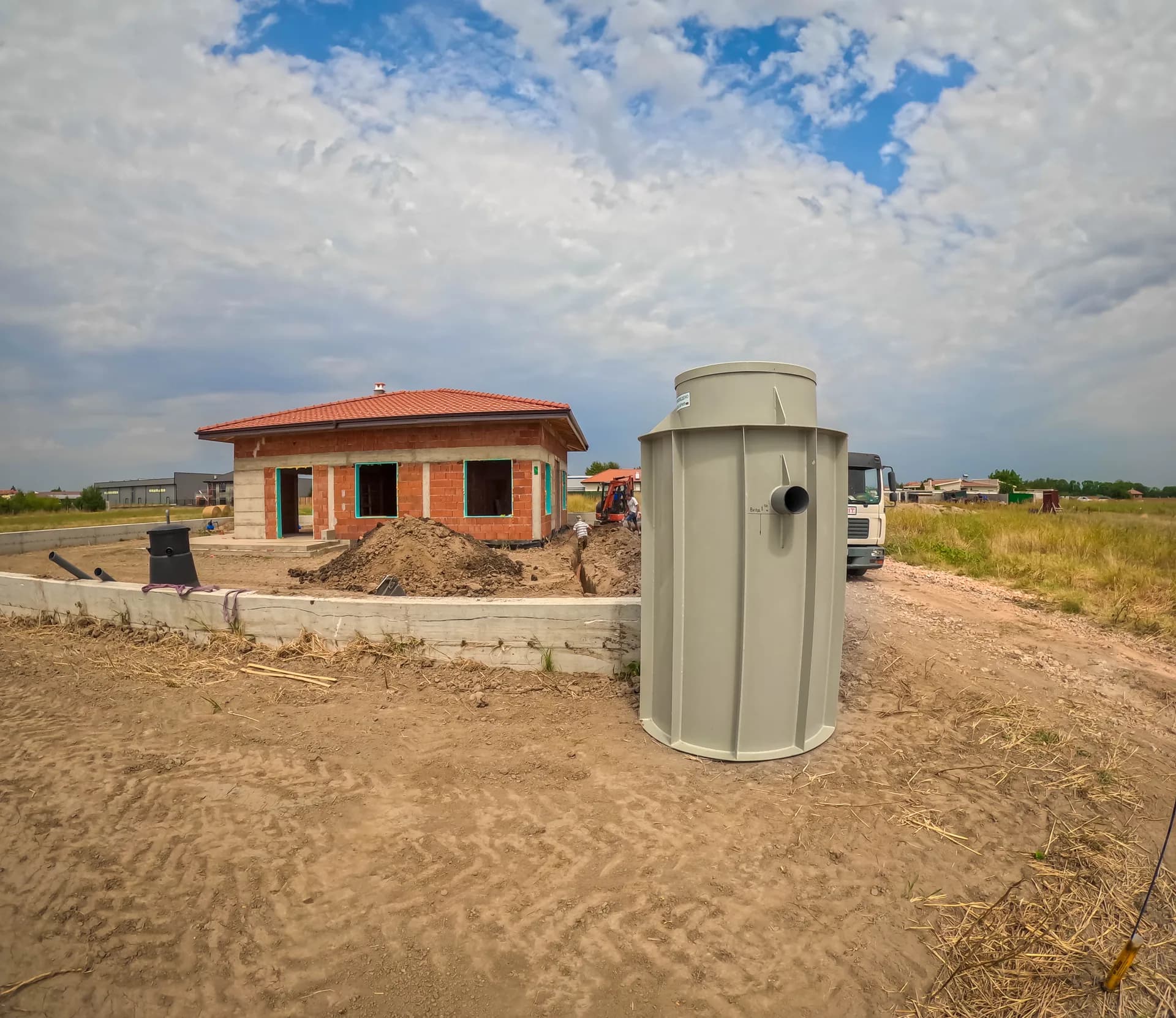
If your house is not connected to the public sewer, sooner or later you face the same question: a septic tank or a wastewater treatment plant for a house? Both collect domestic wastewater on site, but they work in very different ways, need different care and suit different ways of living.
In this article ERMAX BG compares the two options point by point: how they work, how they are maintained, what leaves the property, how much space they take and when each one is the sensible choice.
How a septic tank works
A septic tank is a closed underground vessel that collects the wastewater from the house. Solids settle inside it and part of the organic matter breaks down naturally, without any forced air supply. The tank works by gravity and needs no electricity.
It is important to understand that a septic tank mainly holds wastewater and partly stabilises it, but it does not treat it biologically. The contents build up gradually and have to be pumped out and taken away by a specialist vehicle from time to time.
How a biological treatment plant works
A biological treatment plant does not simply store wastewater, it treats it. The process runs through several stages:
- Mechanical separation: coarser particles settle in the first zone of the unit.
- Aeration: a compressor supplies air that keeps the aerobic microorganisms alive, and they break down the organic pollutants.
- Settling: the activated sludge separates from the treated water, which then leaves the plant.
The process is automatic and needs very little input from the owner. The difference is fundamental: a septic tank collects, a treatment plant treats.
Treatment plant for a house or septic tank: a point-by-point comparison
Emptying and maintenance
With a septic tank, the main task is emptying. The more water the household uses, the more often a tanker is needed. In a house that is lived in all year round this quickly becomes a regular expense and commitment.
A treatment plant is not pumped out on a regular basis. Its maintenance is planned: a visual check of the sludge roughly every 6 months, cleaning the compressor air filter every few months and a full service every 12 to 24 months, depending on the load. Surplus sludge is removed by a licensed company. You will find a detailed checklist in our article on how often a treatment plant needs servicing and what maintenance includes.
What leaves the property
With a septic tank, what leaves the property is the contents of the tank, taken away by tanker. With a treatment plant, what leaves the unit is treated water, discharged in the way set out in the project, for example into the ground or into a watercourse. With additional control it can also be used for irrigation. What exactly is allowed for your property depends on the municipality and the discharge point, so check the requirements with the municipality and the Regional Inspectorate of Environment and Water (RIOSV) before installation.
Space and installation
Both units are buried in the garden. For a septic tank, permanent tanker access is essential. For a treatment plant you also need a route for the treated water, a power cable for the compressor and access for servicing. With a high water table or clay soil, both options need extra technical measures, so a site visit before you decide is always worthwhile.
Power supply
A septic tank runs without electricity. A treatment plant uses a compressor that runs continuously, so there is an ongoing, if low, electricity cost.
Permanent or seasonal use
The biological process in a plant relies on microorganisms that need a regular inflow of wastewater. In a home that is lived in permanently this condition is met and the plant runs steadily. In a holiday house used only on some weekends or for a few weeks a year, long periods without load make it hard to keep the biological process going. That is why the pattern of use is one of the most important questions when choosing.
When a septic tank still makes sense
A septic tank is not an outdated solution in every case. It is a sensible choice when:
- the property is not lived in permanently, for example a weekend or seasonal holiday house;
- there is no power supply on site, or it is unreliable;
- the load is small and emptying will not be frequent;
- a tanker can easily reach the unit.
For such sites ERMAX BG offers the SEPTIC 1500 septic tank with a capacity of 4 PE, intended for properties with non-permanent occupancy. It works on gravity and natural processes, with no need for electricity. For larger households, single-family and two-family houses, there is also the SEPTIC 2500 with a capacity of 8 PE.
When a treatment plant for a house is the right choice
A plant is the better solution when:
- the house is lived in all year round;
- you want to stop frequent pumping and the cost and inconvenience that come with it;
- there is an acceptable way to discharge treated water from the property;
- there is power at the installation point;
- you are looking for a long-term solution that runs automatically.
With permanent use, a wastewater treatment plant for a house is usually the more convenient option in the long run, because it replaces frequent tanker visits with planned maintenance. Every unit manufactured by ERMAX BG is supplied with the necessary documentation, and our specialists advise you on what the project requires. To read more about choosing a system, see also our article on which treatment plant to choose for a house without a sewer connection.
BIO-6: the typical solution for a single-family house
For most single-family houses that are lived in permanently, the typical solution is the BIO-6 biological treatment plant, designed for single-family houses and villas:
- Capacity: 6 PE (population equivalent)
- Daily volume: 0.9 m³/24h
- Material: reinforced polypropylene (PP)
- Warranty: 2 years
- Production time: 3–5 working days
- Installation: by the ERMAX BG team, with commissioning by a technical specialist and maintenance under contract
If more people live in the property, or one plant will serve several homes, the BIO 6–25 series, with a capacity of 6–25 PE and a daily volume of 1–4 m³/24h, is the better fit.
Frequently asked questions
Can I replace an existing septic tank with a treatment plant?
Often it is, but the decision is made after a site visit. It assesses the location, the fall of the sewer pipes and how the treated water will be discharged, and the right solution is then proposed.
How many PE do I need for a house?
PE (population equivalent) expresses the load a plant can handle and is set mainly by the number of people using the property. Allow for guests and for a family that may grow, so that the plant does not end up overloaded.
Does a treatment plant smell?
A correctly selected, professionally installed and regularly maintained unit should not give off unpleasant odours. A smell is usually a sign that a check is due.
Can a treatment plant be used at a holiday house?
It can, but the technology and maintenance regime must take the breaks in use into account. Where use is very infrequent, a septic tank is often the more practical option.
Every property is different, and the safest choice is made after a site assessment. If you are weighing up a septic tank against a wastewater treatment plant for a house, get in touch with us: tell us how many people live in the property, how you use it and what the ground is like, and our specialists will help you choose the solution that will serve you quietly for years.