

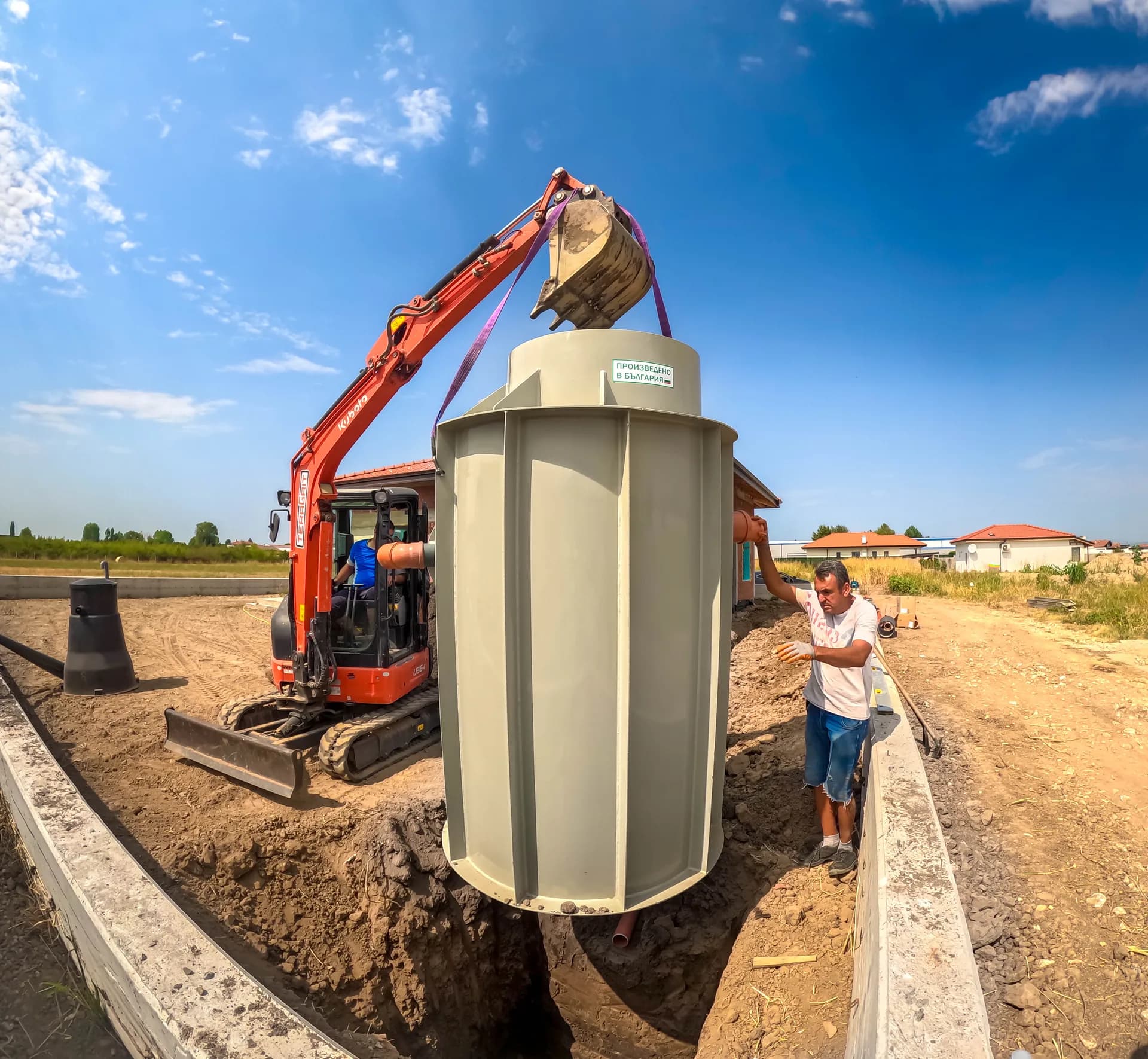
"How much does a treatment plant cost?" is the first question we hear from almost every client looking at wastewater treatment plants for their property. The honest answer is that the price of a wastewater treatment plant depends not only on the unit itself, but also on the site where it will be installed. Two identical plants on two different properties rarely come to the same total.
In this article we look at the factors that determine the final price of wastewater treatment plants for houses, hotels and larger sites, what you pay in the years after installation, and what information to send us to get an accurate quote.
Capacity: how many population equivalents (PE) the plant serves
The most important factor is capacity. It is expressed in population equivalent (PE) and as a daily wastewater volume in m³/24h. A higher capacity means a larger tank, more powerful equipment and more earthworks. As a guide, the ERMAX BG biological treatment plants cover:
- BIO-6: 6 PE and 0.9 m³/24h, for single-family houses and villas;
- BIO 6–25: 6–25 PE and 1–4 m³/24h, for small residential and hotel sites;
- BIO 30–200: 30–200 PE and 5–30 m³/24h, for holiday complexes;
- BIO 250–2000: 250–2000 PE and 38–300 m³/24h, for settlements and industrial sites.
Correct sizing saves money in two ways. A plant that is too small becomes overloaded and works inefficiently, while one that is too large is an unnecessary investment. That is why capacity is set by the real number of users and the pattern of use, with a sensible margin for future load. The type of wastewater matters too. For domestic wastewater from kitchen, bathroom and toilet, a standard biological treatment plant is enough. If water containing fats from a commercial kitchen enters the drains, however, a grease trap is added upstream of the plant as a separate item in the quote, and process water from production calls for a bespoke solution. You can compare all series in the treatment plants section.
Technology: flow-through or SBR
Flow-through plants work with a continuous flow, with the water passing through several chambers in turn. SBR systems treat water in cycles in a single tank, with the stages controlled automatically. The different design, automation and control are also reflected in the price.
Which one suits you depends above all on the load. With permanent occupancy, flow-through technology can be a stable solution, while with seasonal or strongly varying loads SBR usually adapts better. Choosing a technology purely for a lower initial price often proves expensive later. You will find a detailed comparison in our article on the difference between flow-through and SBR technology.
Installation and earthworks: the hidden part of the price
Installation often carries real weight in the final total, and it depends entirely on the specific property. This is what affects it:
- Soil: digging in rocky or clay ground needs different machinery and more time.
- Groundwater: a high water table calls for extra measures during excavation and when anchoring the unit.
- Access for machinery: if an excavator or crane cannot reach the spot, the work becomes more complex.
- Distance and depth: the length of pipe from the house to the plant and the depth of the sewer outlet. If gravity flow is not possible, a pumping station may be needed.
- Power supply: a cable to the compressor and the control panel.
It is precisely because of these factors that the ERMAX BG team carries out a technical site visit before giving a final quote.
Distance, discharge and documents
The distance to the site affects transport and the logistics of the installation team. ERMAX BG works across the whole country, and delivery and installation are planned according to where the property is.
The second big question is where the treated water goes. Discharge into the ground, into a watercourse or reuse for irrigation each call for different additional elements, such as drainage or a tank, and sometimes different documents. Requirements depend on the municipality and the discharge point, so check with the municipality and the Regional Inspectorate of Environment and Water (RIOSV) what applies to your property. Every unit manufactured by ERMAX BG is supplied with the necessary documentation, and our specialists advise you on the technical side of the project.
Total cost of ownership: what you pay after installation
The purchase price is only the beginning. To compare quotes for wastewater treatment plants fairly, look at the total cost over the years of use:
- Electricity: the compressor runs continuously, so there is an ongoing, if low, power cost.
- Servicing: a planned service every 12 to 24 months, cleaning the compressor filter and replacing wearing parts such as diaphragms and filters.
- Sludge removal: surplus sludge is periodically taken away by a licensed company.
- Bioproducts: optional, to keep the biological process stable, especially after a period of downtime.
- Warranty and maintenance: the BIO series carries a 2-year warranty, and maintenance is agreed separately.
A cheap but unsuitable plant usually leads to more frequent repairs and lower efficiency, which eats up the initial price difference. Read more about servicing in our article on how often a treatment plant needs servicing.
How to get an accurate quote for treatment plants
An exact price can only be given after assessing the site. The more complete the information you send, the faster and more accurate the proposal. Please prepare:
- the location of the property (town or village);
- the type of site: house, holiday home, hotel, restaurant, production;
- the number of occupants or users, including at peak times;
- the pattern of use: all year round or seasonal;
- the type of wastewater: domestic, or containing kitchen fats (in which case a grease trap may also be needed);
- photos of the spot and the approximate distance from the building;
- the depth of the sewer outlet, if you know it;
- anything known about the soil and groundwater;
- how you would like the treated water to be discharged;
- whether you need supply only, or supply with installation and maintenance.
Frequently asked questions
Can you give me a price over the phone?
On a call we can discuss your needs and the right series, but the exact price of a treatment plant comes with a quote once we have assessed the capacity, the ground and the discharge option. That way you avoid surprises during installation.
Is installation included in the price?
It depends on the quote. ERMAX BG offers delivery, installation by our own team, commissioning by a technical specialist and maintenance under contract. Ask exactly what each quote you are comparing includes.
How long does production take?
It depends on the series: BIO-6 takes 3–5 working days, BIO 6–25 takes 5–10, BIO 30–200 takes 10–20 and BIO 250–2000 takes 20–60 working days.
Is it cheaper to choose a smaller plant?
Rarely. An overloaded plant treats water less well and needs more frequent attention, so what you save at the start is usually lost in operation.
If you are planning a project and want a clear figure, get in touch with us. Send us the details from the list above and our specialists will prepare a quote based on your site rather than on general assumptions.