

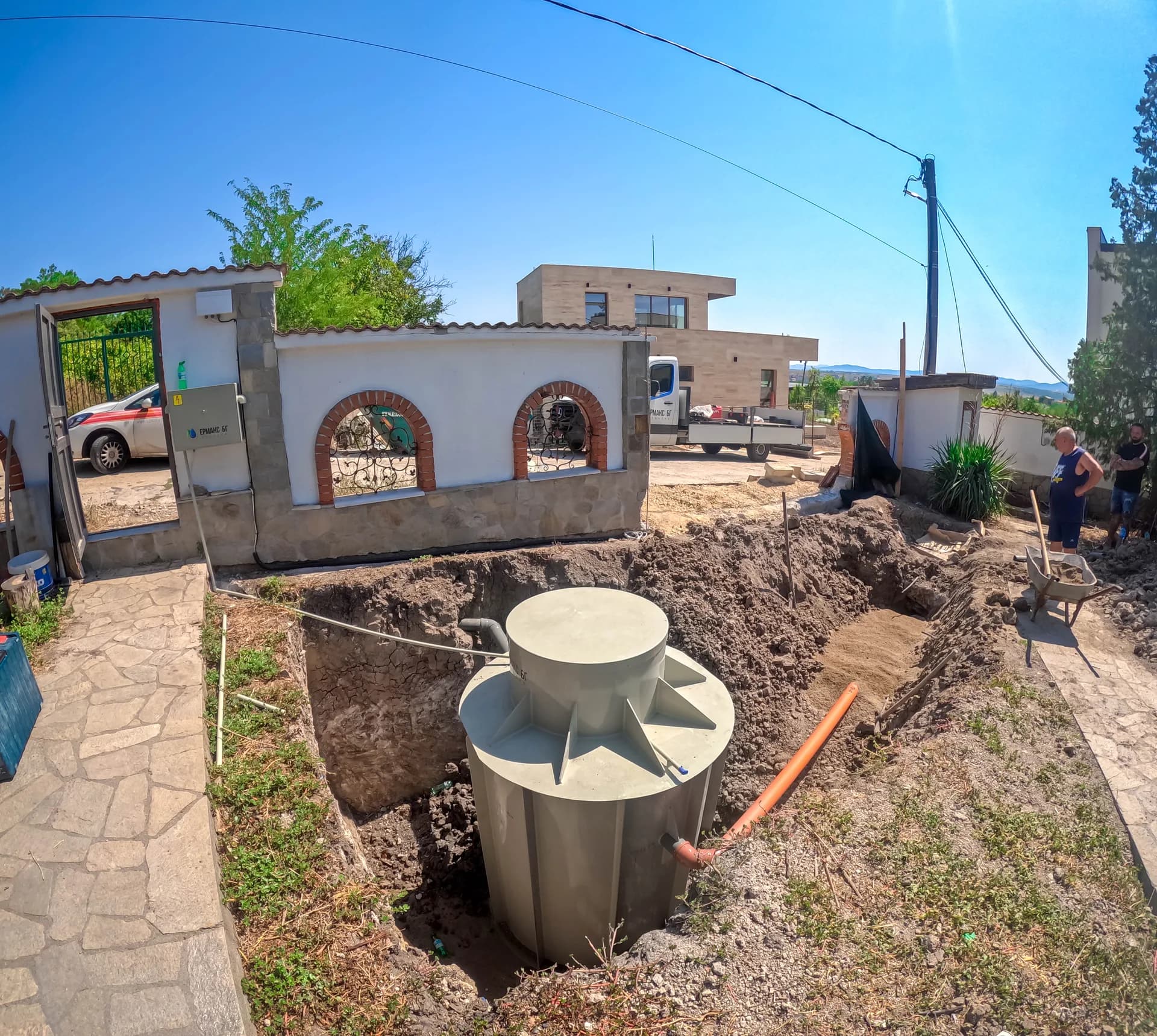
Where you place a wastewater treatment plant for a house determines how easy it will be to service, how much excavation and pipework it needs and whether the treated water has somewhere to go. The decision is made once, and its consequences are felt for years.
In this article ERMAX BG sets out the practical criteria for choosing a location in the yard. We cover the installation itself step by step in a separate article: how a wastewater treatment plant for a house is installed.
Connection to the house outlet and slopes
Wastewater from the house usually reaches the plant by gravity, through a pipe with a constant fall. That is why the starting point is where, and at what depth, the sewer pipe leaves the building.
- The further away the plant is, the deeper the pipe arrives at its inlet, because the fall has to be kept along the whole length. A deeper inlet means a deeper excavation.
- A shorter, straighter route with few bends reduces the risk of blockages. Where bends cannot be avoided, inspection chambers are provided.
- If the plant has to sit higher than the house outlet, or the terrain does not allow gravity flow, a pump unit is added. In the Projects section you will find sites where the plant was installed together with a pump unit.
Choosing a location starts with measuring the sewer outlet and the level differences in the yard, not with looking for a free corner.
Access for service
The plant has covers through which the sludge, the aeration system and the treated water outlet are checked. Place it where:
- the covers stay visible and accessible, not covered by paving, decorative stones or flower pots;
- a vacuum truck can get close when excess sludge is removed by a licensed company;
- there is room to work around the covers during a service visit.
You will find what regular servicing involves in our article on how often a treatment plant is serviced and what maintenance includes.
Where the treated water goes
The location of the plant has to be considered together with the treated water outlet, because that is often the bigger constraint. The options are defined by the project:
- Infiltration into the ground through drainage or a soakaway, where the soil drains well enough.
- Discharge into a receiving water body, such as a ravine, a channel or a river, where one is nearby and the project provides for it.
- A treated water tank with a pump, from which, with additional control, the water can be used for irrigation.
Discharge requirements and minimum distances to buildings, property boundaries, wells and water sources depend on local requirements and on the project. Do not rely on general rules; check with the municipality and the Regional Inspectorate of Environment and Water (RIOSV) what applies to your property. For the different drainage options, see our article on choosing a drainage system.
Power supply for the compressor
A biological treatment plant uses a compressor that supplies air and runs continuously. When choosing the location, plan for:
- a power cable from the house to the compressor, laid and protected according to the requirements and installed by a qualified electrician;
- a place for the compressor that is protected from flooding and direct water, with air access for cooling;
- a distance between the compressor and the plant agreed with the supplier, so that air delivery stays efficient.
If the compressor is close to a seating area or a bedroom window, think about its sound as well, even if it is quiet.
What to avoid when placing a wastewater treatment plant for a house
- Driveways, parking spaces and areas with vehicle traffic, unless the plant and its covers are designed for that load in the project.
- Proximity to trees and large shrubs. Roots make excavation harder and can grow into the pipes and drainage over time, and falling leaves collect around the covers.
- Low spots where surface water collects after rain. Rainwater should not run towards the covers and get into the plant.
- Areas above underground utilities such as water pipes, cables and gas lines.
- Areas for future construction such as a pool, a garage or an extension. Think about what you will build in the coming years so that the plant does not have to be moved.
Soil and groundwater
Before the final decision it is worth knowing what lies below the surface:
- A high water table loads the body from outside and can push an empty plant upwards. In that case additional technical measures for anchoring are provided, and the excavation is dewatered during installation.
- Clay soil lets water through poorly, which mainly affects infiltration of the treated water. Another way of discharging it may be needed.
- Rocky ground makes excavation harder and more expensive, so it is sometimes worth moving the location slightly.
- Backfilled ground after construction has to be compacted, or the excavation has to reach stable ground.
A site visit by a specialist settles most of these questions before excavation begins.
Frequently asked questions
How far from the house can the plant be?
There is no single correct distance. It is limited by the fall of the pipe, the depth of excavation and local requirements. With a longer distance or unfavourable terrain, the solution is usually a pump unit.
Can the plant go under a driveway or parking space?
Only if the plant and its covers are designed for that load in the project. In all other cases, place it in a green area without vehicle traffic.
Do I need a permit for a wastewater treatment plant for a house?
Requirements depend on the municipality and on the discharge point of the treated water. Check with the municipality and RIOSV before you start the installation.
Which model suits a single-family house?
For single-family houses and holiday homes ERMAX BG offers the BIO-6, with a capacity of 6 PE and a daily volume of 0.9 m³. For larger households or several homes on one property, a model from the BIO 6–25 series is chosen according to the number of occupants.
If you are choosing a location for a wastewater treatment plant for a house and are not sure which option is best, contact ERMAX BG. An engineer will look at the ground, the sewer outlet and the options for discharging the treated water, and propose a location that works today and years from now.