

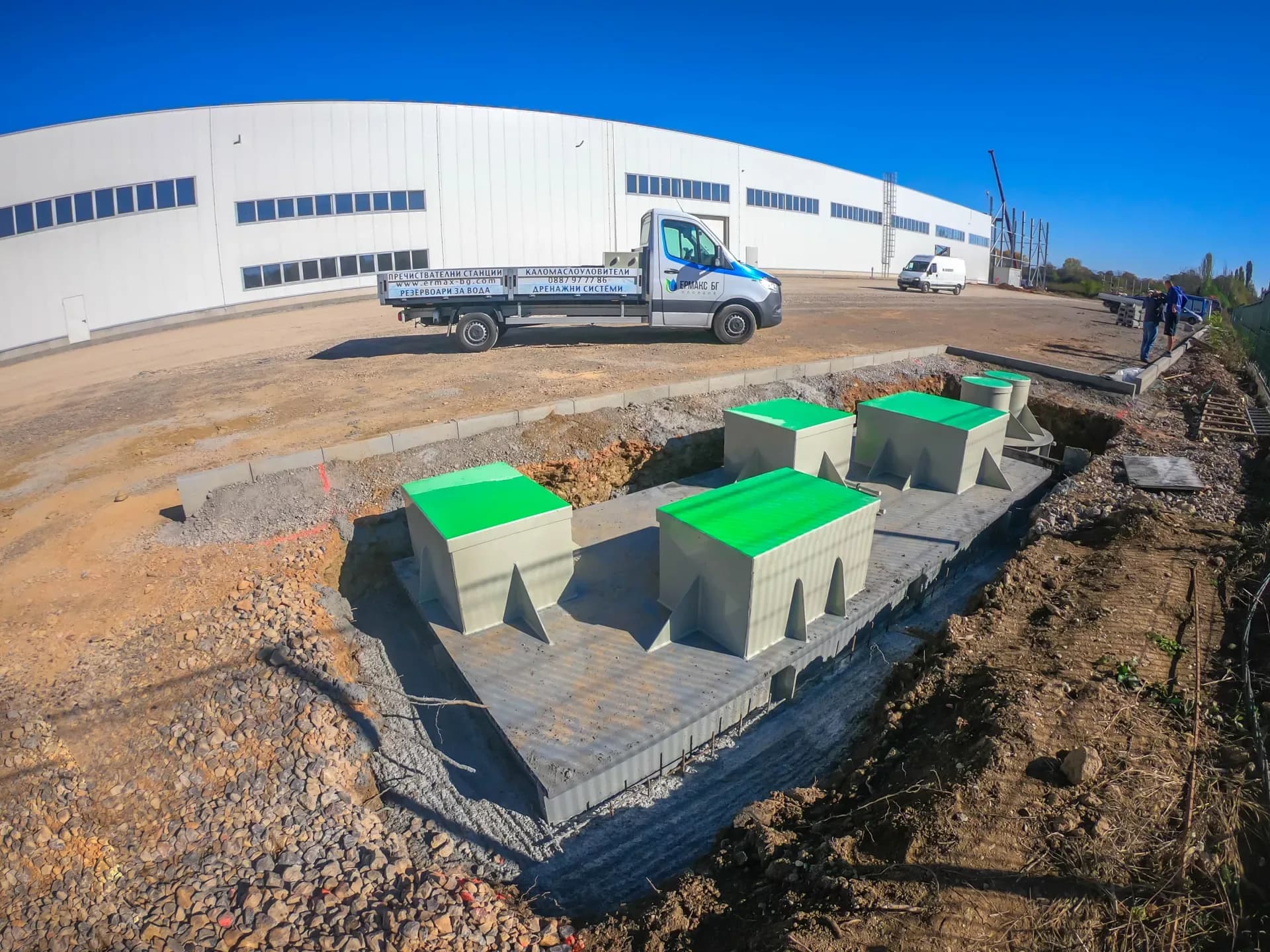
When the project is a village, a neighbourhood, a holiday resort or a production plant, wastewater treatment plants of this scale are not chosen from a catalogue the way they are for a single house. Every solution starts with data about the site and ends with commissioning and maintenance under contract. For such sites ERMAX BG offers the BIO 250–2000 series, intended for settlements and industrial sites.
In this article we explain what changes at a larger scale, what design data is needed, when pre-treatment is required and how a project runs from the first site visit to service.
The BIO 250–2000 series at a glance
BIO 250–2000 plants cover a load of 250 to 2000 PE (population equivalent) and a daily wastewater volume of 38 to 300 m³. The body is made of reinforced polypropylene. Consultation is led by an on-site engineer, installation is carried out by the ERMAX BG team, commissioning by a technical specialist, and maintenance is agreed separately. The warranty is 2 years.
Above 2000 PE the approach is defined individually, after analysing the site data. If your site is smaller, for example a hotel, a holiday complex or an agricultural site, the BIO 30–200 series may be the right fit.
What is different about large wastewater treatment plants
For a single-family house the load is fairly predictable. For a settlement or a production plant there are more variables, and each of them affects the technology and the size of the facilities.
Design data
- the number of residents, guests or employees to be served today, and expected growth in the coming years;
- the daily wastewater volume and the maximum hourly inflow;
- the type of wastewater: domestic, industrial or mixed;
- the required quality of the treated water, which depends on the discharge point;
- site conditions: terrain, groundwater, access for machinery and available power supply.
Flow variation
The inflow to the plant is not even. Settlements have morning and evening peaks, and in resorts the load changes significantly between seasons. In industry the flow often follows work shifts, and washing down equipment produces short but strong peaks. On top of that, rainwater and groundwater get into the sewer network. That is why the design usually includes an equalisation volume that smooths out the peaks, and the technology is chosen so that it runs stably at lower loads as well.
Industrial wastewater: characterisation before selection
Industrial wastewater differs from domestic wastewater, and it should not be assumed that a biological plant will handle it without checking. Before design the wastewater has to be characterised: samples are taken and its composition is analysed, taking into account:
- the organic load and how it varies;
- the content of fats, oil products and suspended solids;
- acidity (pH) and temperature;
- the presence of substances that can inhibit the biological process, such as strong cleaning and disinfecting agents;
- the discharge pattern: continuous, by shifts or in batches.
Based on this data it is decided whether the industrial wastewater can be treated together with the domestic wastewater, whether it needs pre-treatment or a separate line.
Pre-treatment and pumping stations
The biological stage works best when the incoming water is free of coarse waste, fats and oil products. That is why treatment facilities of this scale are often preceded by:
- Screens and grit chambers for coarse waste and mineral particles.
- Grease traps for kitchens, canteens and food service outlets. ERMAX BG offers MU 1–10 grease traps with a capacity of 1 to 10 l/s.
- Oil and sludge separators for car services, warehouse and transport areas, where the water carries oil products and sludge. The KMU 1–200 series covers 1 to 200 l/s.
When the terrain does not allow gravity flow, pumping stations are added to the system. They are sized for the peak inflow, usually with a standby pump and reliable controls, because if they stop, the whole system stops. We cover this in detail in our article on how to design an efficient pumping station.
Project stages for wastewater treatment plants
- Assessment. A site visit, collecting data on the load, the wastewater and the ground, and confirming the discharge point.
- Design. Choosing the technology and sizing the plant, the pre-treatment, the pumping stations and the treated water outlet. Permit requirements depend on the municipality and the discharge point, so check them with the municipality and the Regional Inspectorate of Environment and Water (RIOSV) at this stage.
- Supply. Manufacturing and delivery of the facilities according to the design.
- Installation. Construction and installation work on site, pipe connections, power supply and controls, carried out by the ERMAX BG team.
- Commissioning. A technical specialist starts up the system, checks the equipment and monitors how the biological process establishes itself.
- Service. Maintenance is agreed separately and includes periodic checks, equipment servicing and management of excess sludge.
An example of a more complex site from our work is a BIO-200 treatment plant installed together with two pump units and a grease trap in the village of Hristianovo near Stara Zagora. You will find more sites, including BIO-100 and BIO-150 plants, in the Projects section.
Frequently asked questions
What does PE mean?
PE (population equivalent) is a notional unit that expresses the pollution generated on average by one resident. It is used to compare sites of different types, including production plants, whose wastewater is converted into an equivalent load.
Can one plant treat domestic and industrial wastewater together?
Sometimes, but only after the industrial wastewater has been characterised. In many cases pre-treatment is needed, and sometimes a separate line, so that the biological process is not disrupted.
How long does a project take?
It depends on the scale, the time needed for design and approvals, and how ready the site is. We can give a realistic schedule after the assessment in the first stage.
Who maintains the plant after start-up?
ERMAX BG offers maintenance under contract, which includes periodic servicing of the facilities and process checks. This gives the owner or operator a clear schedule and one partner for the whole system.
If you are preparing a project for a settlement, a resort or a production site, contact ERMAX BG. The earlier you involve an engineer, the more certain it is that wastewater treatment plants of this scale are sized on real data rather than assumptions.