

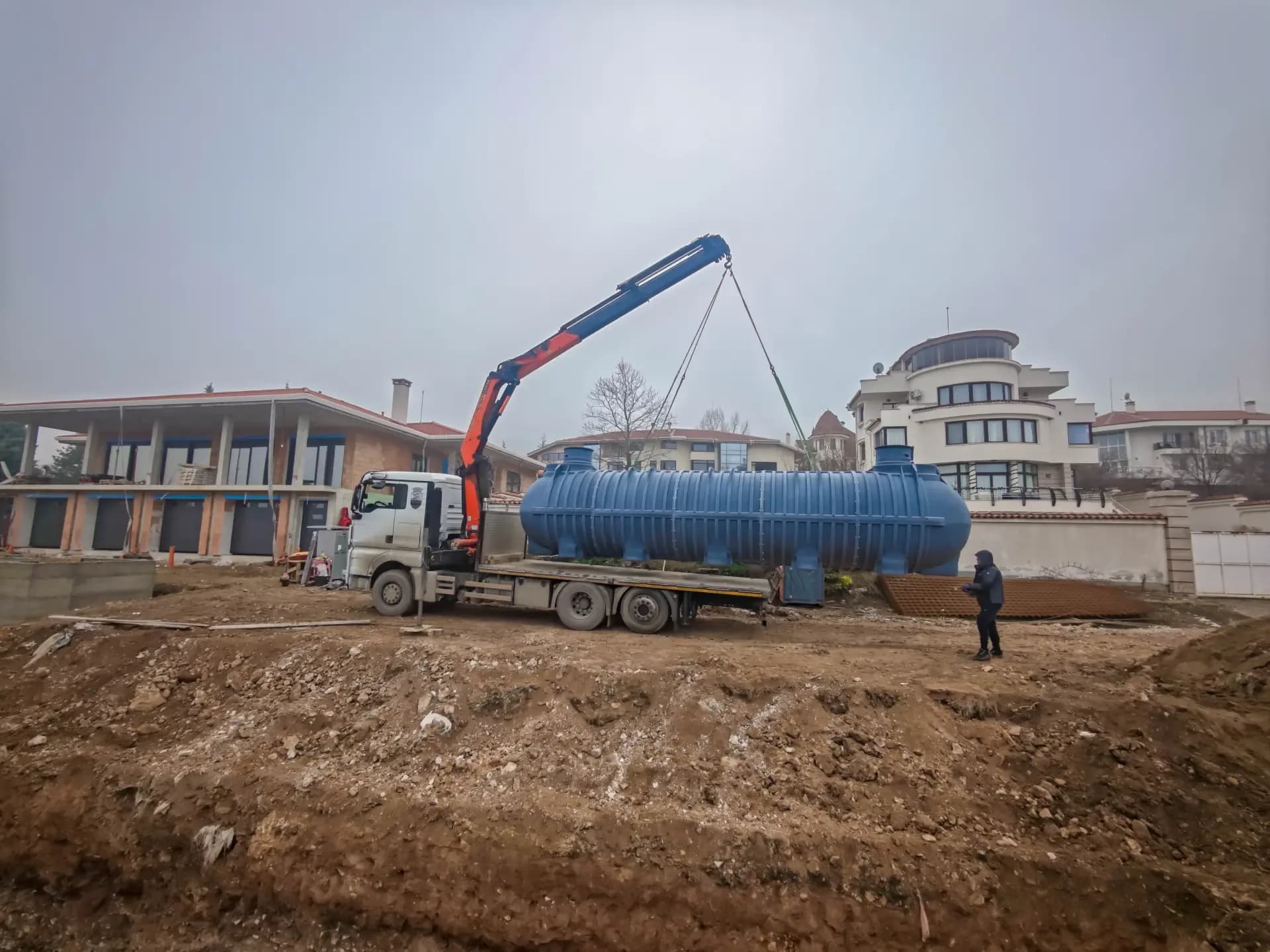
Every rainfall on your roof is a free resource that usually runs through the gutters into the sewer or the yard. Rainwater tanks let you hold on to that water and use it where mains water is not needed: for irrigation, washing and other household technical uses.
In this article ERMAX BG explains how to approach such a system: what the water can be used for, how to think about volume, when the tank should be above ground and when underground, how the incoming water is filtered and how a pump is added.
What you can use rainwater for
Water collected from the roof carries dust, leaves, pollen and other contaminants from the roofing and the gutters. That is why we only discuss technical uses here, where the water is not drunk and not used for preparing food. The most common are:
- Irrigation of gardens, lawns, vegetables and fruit trees. This is the simplest and most widespread use.
- Washing paths, terraces, cars, garden tools and equipment.
- Toilet flushing, where the building installation allows it. This requires a separate pipe network for rainwater that is not connected to the mains water supply. Such a solution is planned when the installation is designed and is carried out by a specialist.
The more of these uses you connect to the system, the more fully the tank volume is used and the more tangible the benefit.
How the tank volume is determined
There is no universal correct volume. The choice is a balance between three factors:
- Roof area. What counts is the plan area of the roof, meaning the horizontal projection that drains to the tank, not the area of the roof slopes. If only some of the gutters are connected to the tank, count only that part.
- Rainfall. The amount of rain per year and how it is spread across the months depend on the region. What matters is not only how much it rains but also when: if summers are dry, the tank has to store a reserve from the wetter months.
- Consumption. How much water you need for irrigation, washing or toilets, and in which period. Irrigation is concentrated in the warm months, while toilets use water all year round.
Not all the water that falls on the roof reaches the tank. Some evaporates, and some is lost in the filter and when the first, most polluted flow is diverted. Exactly how much depends on the roofing, the gutters and the filter, so the calculation is done with the real data for the specific property.
The practical approach is to compare how much water you can collect with how much you need. If the roof can collect much more than you use, a larger tank will bring no extra benefit. If your needs are large, the roof is the limit, and it is sensible to plan an additional source. ERMAX BG water tanks are available in volumes from 2 to 300 m³, so they can suit both a small yard and a large site.
Rainwater tanks: above ground or underground
Above-ground tank
An above-ground tank is easier to install: there is no excavation, and access for inspection and cleaning is direct. It suits smaller volumes and seasonal use, for example irrigation only. The drawbacks are that it takes up space in the yard, it is exposed to the sun, which encourages algae if the walls let light through, and in winter the water in it and in the pipes can freeze unless they are drained or protected.
Underground tank
An underground tank frees up the yard, and the water stays dark and at a more stable temperature, which reduces the risk of algae and freezing. On the other hand, it needs excavation, a pump to deliver the water and a careful assessment of the ground. With a high water table an empty tank can be pushed upwards, and if it is installed under a driveway or parking space it must be designed for that load. These questions are settled during the site visit and design, not during excavation. You will find more about materials and construction in our article on designing water tanks.
Filtering the inflow and the overflow
The quality of the collected water depends more on what enters the tank than on the tank itself. A well-built system has several elements:
- Gutter guards that hold back leaves and larger particles.
- A filter before the tank that removes finer contaminants before the water goes in. The filter must be accessible, because it is cleaned periodically.
- First-flush diversion. The first water of each rainfall washes the roof and is the most polluted, so it is useful to divert it.
- A calmed inlet. Water enters at the bottom of the tank in a way that does not stir up the sediment on the floor.
- Suction below the surface. The pump draws water just below the water surface, where it is cleanest, not from the bottom.
The overflow is just as important. When the tank is full, the excess water needs somewhere to go: into drainage, an infiltration system or the sewer, if that is permitted for your property. The overflow is protected against backflow and against odours and rodents getting in. The right solution depends on the ground and on local requirements, and you will find useful guidance in our article on types of drainage systems.
Pump and water delivery
With an above-ground tank used for irrigation, gravity or a small pump is often enough. With an underground tank, or when supplying toilets, the pump is an essential part of the system. Usually this is a submersible pump inside the tank or a surface pump with a pressure vessel, depending on the distance to the points of use and the pressure required.
The pump should have dry-run protection. When toilets are supplied, a way of topping up from the mains when the tank is empty is also provided, without connecting the two networks directly. How a pump unit is sized and maintained is covered in detail in our article on how to design an efficient pumping station.
ERMAX BG water tanks
ERMAX BG supplies and installs water tanks made of reinforced polyethylene in volumes from 2 to 300 m³, with the material and design confirmed per project according to the volume, the installation site and the loads. The tanks are used for different types of water, including rainwater. An engineer visits the site and helps you choose the volume and the connection layout, installation is carried out by the ERMAX BG team, and maintenance can be agreed separately. In the Projects section you will find sites where a rainwater tank was installed together with a wastewater treatment plant.
Frequently asked questions
Can the rainwater from the tank be used for drinking?
In this article we treat roof rainwater only for technical uses such as irrigation, washing and toilet flushing. If you are considering another use, discuss it in advance with a specialist and the competent authorities.
How big a tank do I need?
It depends on the roof area, the rainfall in your region and how much water you use and when. If you give us this data, an ERMAX BG engineer will help you arrive at a sensible volume without paying for capacity that will never fill.
Do rainwater tanks need a permit?
Requirements depend on the municipality and on where the overflow is discharged. Check with the municipality, and if necessary with the Regional Inspectorate of Environment and Water (RIOSV), what applies to your property before you start work.
How is the system maintained?
Maintenance is simple: periodic cleaning of the gutter guards and the filter, checking the overflow and the pump, and removing sediment from the bottom of the tank when needed. How often depends mainly on the roof and on the trees around the house.
If you are planning rainwater tanks for a house, a holiday home or a larger site, contact ERMAX BG. We will look at the site, discuss how you will use the water and propose a tank and connection layout that suit your yard.