

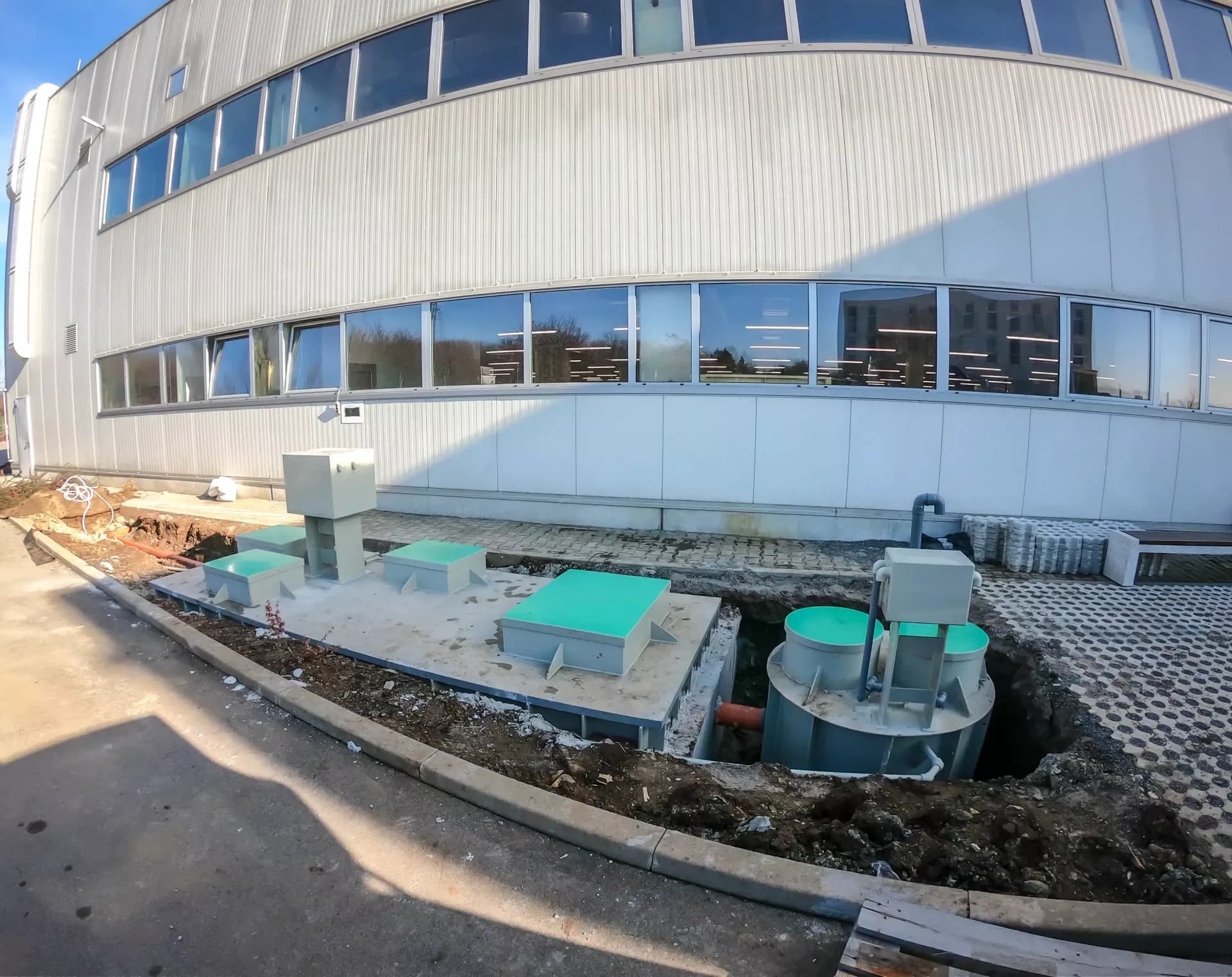
A hotel, guest house or holiday resort that is not connected to the sewer network needs its own wastewater treatment. Wastewater treatment plants for hotels, however, are not chosen like a plant for a house, only bigger. The load changes over the season and over the week, the kitchen brings in fats, and when something goes wrong both the guests and the reputation of the property suffer.
In this article ERMAX BG sets out the essentials to know before you ask for a quote: what capacity is suitable, how peaks are taken into account, why the kitchen needs a grease trap and what data to prepare for the designer.
Treatment plants for hotels: what capacity you need
Capacity is expressed in population equivalent (PE) and in daily wastewater volume. For tourist properties ERMAX BG offers several series:
- BIO 6–25: 6–25 PE and 1–4 m³/24h, for small residential and hotel sites such as family guest houses.
- BIO 30–200: 30–200 PE and 5–30 m³/24h, the series for holiday complexes and larger sites.
- BIO 250–2000: 250–2000 PE and 38–300 m³/24h, for settlements and industrial sites, when the complex is particularly large.
For hotels, the PE figure is not simply the number of beds. The calculation also includes staff, the restaurant, outside visitors to the restaurant, the laundry and additional services. That is why correct sizing starts with the data of the specific property, not with a generic table.
Seasonal and weekly load swings
A seaside hotel may be full in July and almost empty in November. A mountain resort has the opposite profile, and a property near a city fills up at weekends and during events. Treatment plants for hotels have to work reliably in all of these modes.
The biological process needs consistency. With a sudden jump in load, for example on the first weekend of the season, the microorganisms may not be able to handle the whole flow. During a long period with few guests the biomass weakens. That is why the design takes into account:
- the peak day, not the average load over the year;
- the lowest load outside the season and how long it lasts;
- the rate of change: whether the property fills up gradually or all at once.
With a strongly variable load, SBR technology usually adapts better, because it works in cycles and does not depend on a continuous flow. Its advantages and limitations are described in the article pros and cons of SBR treatment plants. If the property will expand in stages, also discuss a modular solution with the engineer that allows capacity to be added later.
The kitchen: a grease trap before the plant
The restaurant and kitchen block are often the underestimated part of the project. Wastewater from sinks, dishwashers and cooking equipment contains fats that harden in the pipes, block the drains and disrupt the biological process in the plant.
That is why, in treatment plants for hotels with a restaurant, kitchen water passes through an MU 1–10 grease trap (1–10 l/s) before it mixes with the rest of the domestic wastewater and enters the treatment plant. The grease trap is sized according to the kitchen's flow and is cleaned regularly. We explain how its size is determined and how often it is serviced in the article grease trap for a restaurant.
Water from pools, spa areas and laundries also needs attention. Chlorine and strong chemicals harm the microorganisms, so how this water is drained must be decided at the design stage.
What data to prepare for the design
With treatment plants for hotels, the more accurate the input data, the more accurately the plant will be sized. Before the consultation, gather the following:
- Number of beds and number of staff, including seasonal staff.
- Occupancy by month and the typical weekly profile: weekdays, weekends, holidays and events.
- Restaurant: number of seats, approximate number of meals per day and whether it serves outside guests.
- Other water users: laundry, spa, pool, gym.
- Site layout: where the plant can be placed, access for machinery during installation and for a truck when sludge is removed.
- A possible discharge point for the treated water and what you know about the groundwater level.
- The power supply available at the plant location.
- Expansion plans for the coming years.
Permit requirements depend on the municipality and on the discharge point. Check them in good time with the municipality and the Regional Inspectorate of Environment and Water (RIOSV), because they affect the design and the schedule.
Installation, commissioning and a service contract
Installation is carried out by the ERMAX BG team and commissioning by a technical specialist. The BIO series plants come with a 2-year warranty. For a hotel, though, maintenance should not happen "whenever someone remembers". A service contract typically includes:
- scheduled inspections before and after the busy season;
- checks of the compressors, aeration and controls;
- sludge monitoring and arranging its removal by a licensed company;
- cleaning the grease trap on a schedule matched to the kitchen's load;
- training staff on what must not go down the drains;
- emergency repairs in case of breakdown.
Well-planned maintenance costs less than a breakdown in a full hotel. It extends the life of the installation and keeps treatment quality stable.
Frequently asked questions
Can one plant serve several buildings in a complex?
Yes, if the capacity matches the total load and the site allows the wastewater to be collected in one place. Sometimes it is more practical to split the property into zones. This is decided during the site visit.
What happens to the plant outside the season?
The plant keeps working at a lower load. During long periods with few guests the biology weakens, so an inspection before the season is a good idea. Bioproducts with enzymes and microorganisms help it recover faster after downtime.
Is a grease trap needed if the hotel has a restaurant?
With a professional kitchen a grease trap is necessary to protect the pipes and the biological process in the plant. Without it, fats gradually reduce treatment efficiency and lead to more frequent breakdowns.
How long does it take to manufacture a plant for a hotel?
Manufacturing takes 5–10 working days for BIO 6–25, 10–20 working days for BIO 30–200 and 20–60 working days for BIO 250–2000. Time for design, paperwork and installation comes on top of that.
If you are planning a new hotel, expanding a complex or replacing an existing system, get in touch with ERMAX BG. Our engineer will visit the site, assess the real load and propose a treatment plant, grease trap and maintenance plan as one complete solution.