

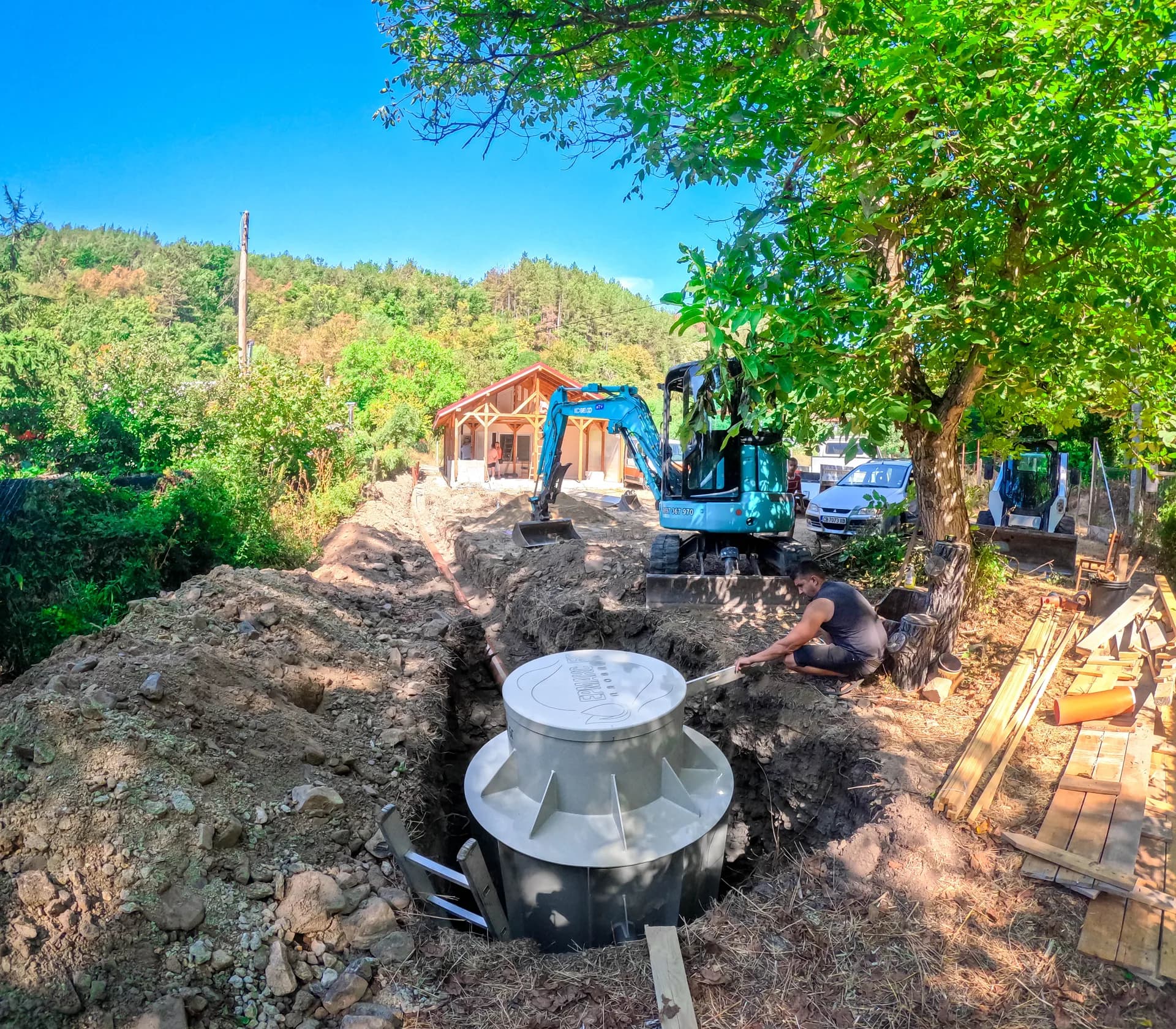
A holiday home is used differently from the house you live in all year: a few full weekends, a week or two in summer, guests over the holidays, and then weeks of silence. That is why a wastewater treatment plant for a villa is chosen by slightly different rules. What matters is not only how many people will use the property, but also how the system copes with breaks in use.
In this article ERMAX BG explains what happens to a biological plant while the villa stands empty, what to do before you leave and after you return, when a septic tank is the more practical choice, and how to size the system for busy weekends.
How a biological plant works and why breaks matter
A biological treatment plant relies on activated sludge: a living mass of microorganisms that break down the organic pollutants in the wastewater. A compressor supplies air, and the bacteria feed on whatever comes in from the house.
When the villa is empty, no "food" reaches the plant. The biomass gradually shrinks and weakens. When you come back the system keeps working, but it needs time to recover its full efficiency. Exactly how long depends on the length of the break, the temperature and the condition of the plant before it.
The technology matters too. Flow-through plants rely on a fairly steady flow, while SBR plants work in cycles within a single volume and cope better with periods of little or no load followed by intensive use. The difference is covered in detail in the article the difference between flow-through and SBR technology.
Before you leave: what to do
- Do not switch off the power to the plant unless your service provider has advised otherwise. The compressor and the controls are part of the process, and it is better for the system to stay in operating mode.
- Avoid aggressive cleaning products during the final clean. Chlorine bleach, acids and strong drain chemicals harm the microorganisms just before a period in which they will get no food anyway.
- Do not flush food scraps, fats or wet wipes down the drains. Whatever enters the plant before a long break will sit there.
- Check the control panel for alarms and make sure the compressor runs normally, so you do not discover a fault only on your next visit.
After you return: how to "wake up" the plant
The first days after a long break are when the biology recovers. A few simple steps help:
- Check the control panel and whether the compressor is running. If there is a fault signal, contact the service team before loading the system.
- If possible, start with normal everyday use rather than a large group of guests straight away.
- Use bioproducts with enzymes and microorganisms. After a period of downtime they help the microflora recover faster, especially at the start of the season.
- Pay attention to the smell and the appearance of the outgoing water. If a deviation does not clear within a few days, call a specialist.
When a septic tank is the practical choice
Not every villa needs a biological plant. If the property is used rarely and by few people, and especially if there is no permanent power supply, a septic tank is often the more sensible solution.
The SEPTIC TANK 1500 L has a volume of 1,500 litres and is designed for 4 PE. It is suited precisely to properties that are not occupied permanently, such as a villa. The system works by gravity and natural processes, so it needs no electricity. For more occupants there is also the SEPTIC TANK 2500 L for 8 PE.
Bear in mind that a septic tank collects and partly stabilises the wastewater but does not treat it biologically. The contents are pumped out periodically, so the location must be accessible to a vacuum truck. You will find a detailed comparison of the two approaches in the article treatment plant for a house or septic tank.
Sizing a treatment plant for a villa: think of the peak weekend
The most common mistake with villas is choosing the system for the two people who come most often rather than for a full house over the holidays. A treatment plant for a villa has to handle the real peak: overnight guests, more showers, the dishwasher and the washing machine all on the same day.
When sizing, answer a few questions:
- What is the largest number of people staying overnight at the same time?
- How often does that happen: a few times a year or every weekend in summer?
- Is there a guest house or extra bedrooms that increase the number of users?
- Do you expect to use the villa more often in future, or to live there permanently?
For a typical villa or single-family house the reference point is the BIO-6: 6 PE and a daily volume of 0.9 m³/24h. If the property regularly hosts more people, the BIO 6–25 series is a better fit, with a capacity of 6–25 PE and 1–4 m³/24h, designed for small residential and hotel sites.
Maintenance rhythm for a seasonal property
Maintaining a plant at a villa follows the same principles as at a permanently occupied house, but it is worth planning it around the season:
- The compressor air filter is checked and cleaned every 3 to 4 months. At a villa it is convenient to do this on your first visit of the season.
- The sludge level should be checked visually about every 6 months.
- A full technical service is carried out every 12 to 24 months, depending on the load. The best time is before the busy season, not in the middle of it.
- A septic tank is emptied as it fills up, and it makes sense to check it before the period with the most guests.
ERMAX BG offers maintenance under contract, so servicing happens on time even when you are not on site.
Frequently asked questions
Will the plant work if the villa stands empty for months?
The plant will not be damaged by a lack of load, but the biology weakens and needs time to recover when you return. Bioproducts and a gradual load in the first days help. For very long breaks, discuss the operating mode with the service team.
Should I switch off the power when I leave?
As a rule, no. The plant is designed to run automatically. If you have a specific reason to cut the power, first ask the service team how this will affect your system.
Which is better for a villa without electricity: a plant or a septic tank?
A biological plant needs power for the compressor and the controls. If the property has no permanent electricity supply, a septic tank is the practical solution, because it works by gravity and without electricity.
Do I need a permit for a treatment plant for a villa?
The requirements depend on the municipality and on where the treated water will be discharged. Before installation, check with the municipality and the Regional Inspectorate of Environment and Water (RIOSV) what applies to your property.
If you are not sure which system suits your villa, get in touch with ERMAX BG. We will discuss how you use the property, how many guests you host and what the site conditions are, and propose a solution that works both on a busy weekend and after a long break.