

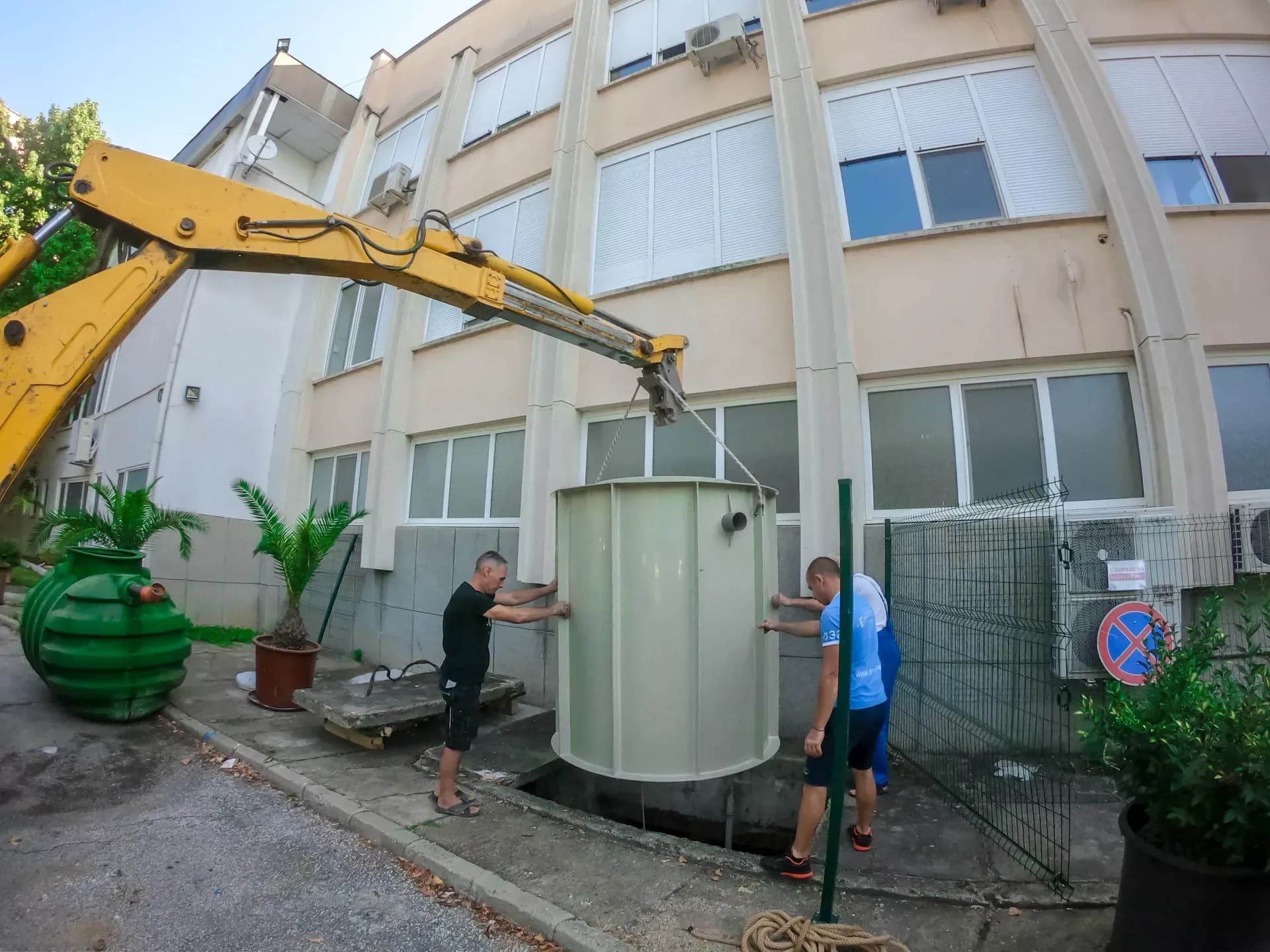
Every commercial kitchen sends water containing fats, food residues and detergents into the drains. A grease trap holds back the fats before they reach the pipes and the sewer, but it only does its job if it is correctly sized and cleaned regularly.
In this guide ERMAX BG explains how the size of a restaurant grease trap is determined, where it should be installed, what a good cleaning routine looks like and how to tell that cleaning is overdue. If you are looking for the basics, start with our article on what a grease trap is and why it is mandatory in a professional kitchen.
Who needs a grease trap
A grease trap is needed wherever food is prepared on a professional scale and fats end up in the wastewater:
- restaurants, fast food outlets and bars with a kitchen;
- hotel kitchens and catering;
- canteens in schools, hospitals and workplaces;
- bakeries, confectionery and meat processing workshops;
- any kitchen block with intensive use.
The specific requirements for your premises depend on the municipality and the discharge point, so check them with the municipality and the Regional Inspectorate of Environment and Water (RIOSV). If the site has its own biological treatment plant, a grease separator upstream of it also protects the biological process, because fats interfere with how the plant works.
How a grease trap is sized: flow rate in l/s
A grease trap is not chosen by the number of tables or the size of the kitchen, but by the maximum wastewater flow it has to handle, expressed in litres per second (l/s). The main reference document in Europe is the EN 1825 standard. Its first part sets out the principles of design, testing and marking of grease separators, and its second part covers the selection of nominal size, installation, operation and maintenance.
Besides the maximum flow, the choice of nominal size takes into account the conditions in which the kitchen operates:
- the temperature of the wastewater, because hot water keeps fats liquid and makes them harder to separate;
- the density of the fats, which depends on the type of food;
- detergents and cleaning agents, which emulsify fats and make them harder to capture.
The maximum flow can be determined in two main ways:
- from the connected appliances: sinks, dishwashers, boiling pans, combi ovens and floor gullies, taking into account which of them actually run at the same time;
- from the number of meals: for catering kitchens, the flow is estimated from the number of meals prepared per day and the hours the kitchen operates.
The calculation is an engineering task and should never be guessed. A unit that is too small cannot hold back the fats at peak load, and they carry on into the sewer. ERMAX BG's MU 1–10 grease traps cover flow rates from 1 to 10 l/s. If the calculated flow for your kitchen falls outside this range, discuss the solution with our specialists.
Where to install it
The right location matters almost as much as the right size. Use these principles when choosing it:
- as close as possible to the source of greasy water, so that fats do not cool and stick to the pipes before the trap;
- outside the rooms where food is prepared, so that odours are not carried in when it is opened and cleaned;
- with easy access for staff and for the tanker that empties it;
- protected from frost if buried outdoors, and with a cover suited to the load above it (pedestrian area or vehicle route);
- connected only to greasy kitchen wastewater, not to toilets or rainwater.
How often a grease trap should be cleaned
There is no single interval that applies to every site. The frequency depends on the size of the unit, the number of meals, the type of cuisine (fried food, grill, meat) and whether you use bioproducts. In practice the schedule is set in the first weeks after start-up: the thickness of the grease layer and the level of sediment are checked, and you observe how quickly they build up.
A good routine includes:
- daily: food scraps go in the bin, not down the sink, and sink strainers are cleaned;
- regular visual checks: inspecting the grease layer and sediment through the inspection opening;
- full emptying: pumping out the fats, water and sediment by a specialist company, and cleaning the walls and baffles;
- refilling: after emptying, the unit is filled with clean water so that it starts separating fats straight away;
- a log: record cleaning dates and the condition of the trap, which helps you fine-tune the schedule.
The removed fats and sediment are waste and are handed over to a licensed company.
Signs that cleaning is overdue
- unpleasant smells in the kitchen or around the cover;
- slow drainage from sinks and floor gullies;
- water backing up into the kitchen;
- a thick, hardened crust on the surface;
- grease in the inspection chamber downstream of the trap;
- frequent blockages in the drains after the premises.
If you notice any of these signs, arrange emptying as soon as possible. If problems keep coming back despite regular cleaning, the unit may be too small for the real flow, and it is worth having the sizing checked.
Bioproducts: a help, not a substitute for cleaning
Bioproducts with enzymes and microorganisms help break down fats, reduce odours and can extend the time between cleanings. They are applied to a schedule, with controlled dosing. They do not, however, replace emptying. Aggressive chemicals and solvents, on the other hand, can emulsify fats and carry them into the sewer, so avoid them. See the ERMAX BG bioproducts.
MU 1–10: grease traps from ERMAX BG
- Flow rate: 1–10 l/s
- Purpose: grease separation
- Suitable for: public catering and kitchen blocks
- Material: reinforced polypropylene (PP)
- Warranty: 2 years
- Production time: 3–5 working days
- Installation: by the ERMAX BG team, with commissioning by a technical specialist and maintenance under contract
If the wastewater contains petroleum products, for example from a car wash or garage, you need an oil and sludge separator rather than a grease trap. We explain the differences in our article oil and sludge separator vs grease trap: which one you need and when.
Frequently asked questions
Can we choose the size by the number of seats in the restaurant?
The number of seats is only an indirect guide. What matters is the maximum flow in l/s, determined from the connected appliances or the number of meals, taking into account temperature, the type of fats and the detergents used.
What happens if the unit is too small?
Fats do not have time to separate at peak load and carry on into the sewer. More frequent cleaning, odours and blockages follow.
Can we clean it ourselves?
Daily care and visual checks are a job for your staff. Full emptying and the removal of fats and sediment are carried out by a specialist company.
Is it needed if the site has a treatment plant?
Yes. A trap upstream of the plant holds back fats and protects the biological process.
If you are opening new premises or having trouble with your current trap, get in touch with us. Send us the number of meals, a list of your kitchen appliances and the proposed installation spot, and our specialists will help you choose the right grease trap and maintenance schedule.