

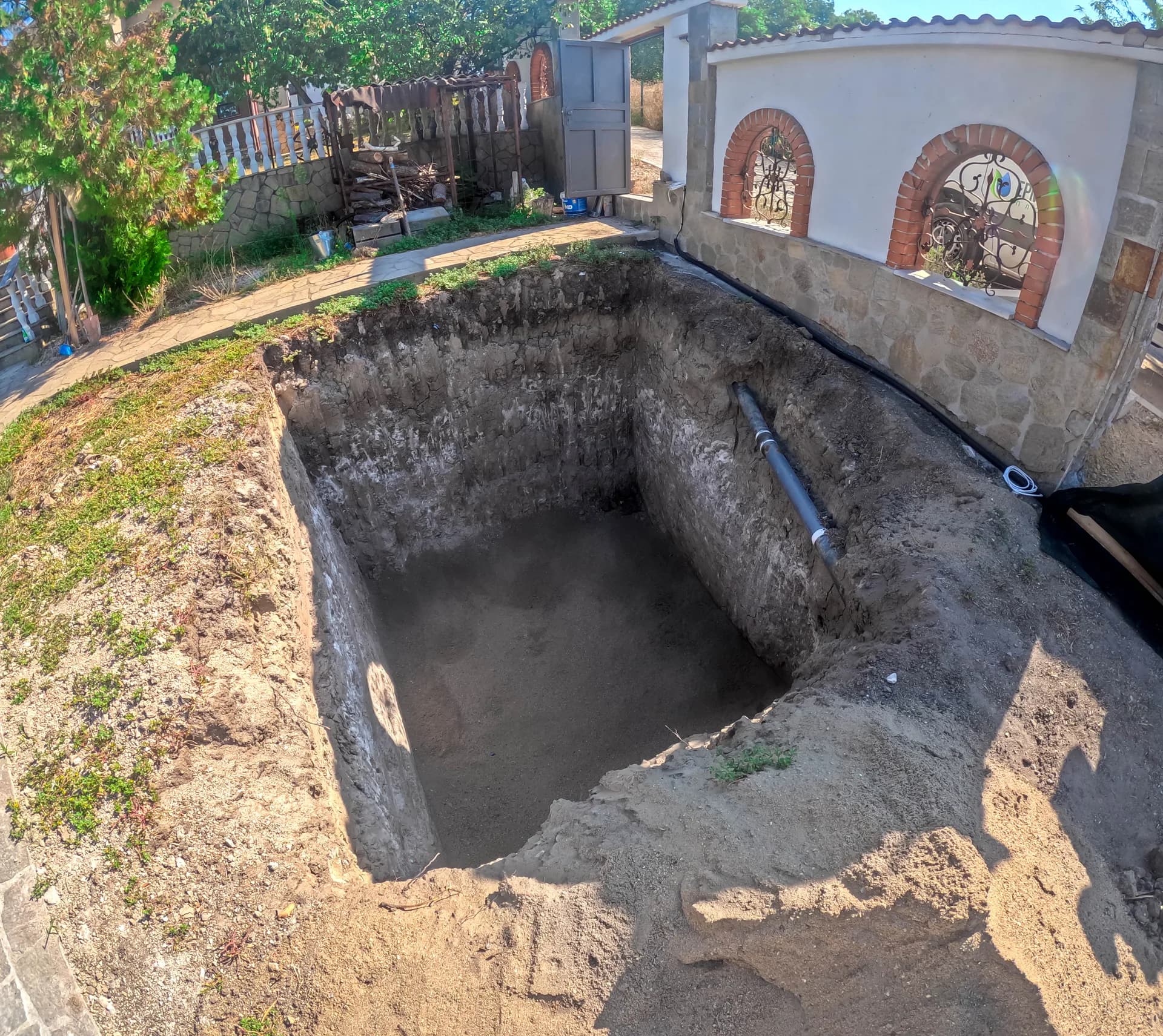
Two houses can have the same number of occupants and the same wastewater treatment plant for a house, yet be installed in completely different ways. The reason lies underground. High groundwater and clay soil are among the conditions that most often call for extra measures. If they are ignored, the plant can shift or the treated water can have nowhere to go.
In this article ERMAX BG explains why ground conditions matter, how the site is assessed and what installers do differently in such cases. The standard steps are described in the article how to install a treatment plant for a house step by step. Here we focus on difficult sites.
A treatment plant for a house on a difficult site: why conditions matter
The plant is an underground tank that has to stay stable, level and watertight for years. The soil around it and the water in that soil have a direct effect on this.
High groundwater
When the groundwater level is high, the water around the plant pushes it upwards, much like a boat in water. While the tank is full, its own weight usually balances this force. The risk is greatest when the plant is empty or partly emptied, for example during installation or when sludge is pumped out during servicing. Without suitable protection the tank can lift, tilt or deform, and the pipe connections can be damaged.
High groundwater also complicates the installation itself: the excavation fills with water, the base is hard to prepare and the sides of the pit are less stable.
Clay soil
Clay holds water and lets it through very slowly. This causes two problems. First, water can collect around the plant even when the groundwater is not particularly high. Second, treated water struggles to soak into such soil, so the usual discharge by infiltration may not be enough. Clay also changes volume as it gets wet and dries out, which puts stress on the tank and the pipes if the backfill is not done properly.
Site assessment: what is checked before installation
On a difficult site the site visit is not a formality but the basis of the whole project. Before the installation method is chosen, the following are checked:
- The groundwater level and how it changes during the year. An observation made in a dry summer month can be misleading, because the level is usually higher in spring.
- The soil type at the depth where the plant will sit and below it.
- How well the soil absorbs water, if the treated water will be discharged into the ground.
- The terrain and slope: where water collects when it rains and where it runs off.
- Possible discharge points: a gully, ditch, drainage system or another receiving water body.
- Access for machinery during installation and for a truck during later servicing.
It also helps to share what you know from experience: is there water in the basement or in nearby excavations, does the yard get waterlogged after rain, what did you see when the foundations or a well were dug?
What installers do differently
The specific measures depend on the results of the site visit, but general practice on high groundwater and clay soils includes several approaches.
Dewatering the excavation during installation
If the pit fills with water, it is pumped out temporarily so the base can be prepared, levelled and compacted. The plant should not be placed in a pit full of water or on a softened base.
Anchoring and ballast against uplift
To stop an empty tank from lifting, it is fixed to a heavy base, most often a concrete slab, or secured with sufficient ballast. The fixing method and the weight required are determined by the size of the plant and the groundwater level. This is one of the most important differences from a standard installation.
Proper backfill
The excavated clay is not put back around the plant. A suitable granular material is used instead, placed in layers and carefully compacted. As the backfill goes in, the tank is gradually filled with water to balance the pressure inside and out. This way the plant keeps its shape and position.
Draining water away from the plant
Where the ground holds water, drainage around the plant is sometimes provided so that water does not collect in the backfill. Possible solutions are covered in the article types of drainage systems.
Where the treated water goes when the soil does not absorb it
On clay soil or high groundwater, discharging the treated water needs its own solution. Depending on the property, the options include:
- discharge into a receiving water body such as a gully, ditch or river, if there is one nearby and this is permitted;
- a larger infiltration area, or one built shallower, above the groundwater level;
- pumped discharge, when the treated water has to be taken to a higher or more distant point;
- collection in a tank for reuse, for example for irrigation, when this is part of the design and additional control is in place. ERMAX BG offers water tanks from 2 to 300 m³.
Which option is possible depends on the municipality and on the discharge point. Before you settle on a solution, check the requirements with the municipality and the Regional Inspectorate of Environment and Water (RIOSV).
Maintenance on difficult sites
Site conditions also affect servicing. Where groundwater is high, the plant should not be emptied completely without a specialist's assessment, because an empty tank is most vulnerable to uplift. That is why sludge removal is best entrusted to a service team that knows how the plant was installed. Besides the usual checks of the compressor and sludge, on such a site it is worth watching the level of the covers, the condition of the connections and whether water collects around the plant. For a full picture of maintenance, see the article how often a treatment plant is serviced.
Frequently asked questions
Can a treatment plant for a house be installed where groundwater is high?
Yes. High groundwater is not an obstacle, but it requires extra measures: dewatering the pit during installation, anchoring or ballast against uplift and careful backfill. It is important to plan these measures in advance, after a site visit.
What happens if the plant is not secured against uplift?
While the tank is full there may be no visible problem for a long time. The risk shows when it is empty or partly emptied, for example during a service pump-out, especially in periods of high groundwater. The plant can then lift or tilt and the pipe connections can be damaged.
Do I need a larger plant if the soil is clay?
Not necessarily. Capacity is determined by the number of occupants, for example 6 PE for the BIO-6. Clay soil affects the installation and the discharge of treated water, not the size of the plant.
Can I judge the groundwater level myself?
Your observations are valuable, but they do not replace a site visit. The level changes during the year, and for a correct installation it is important to know its highest position. That is why we recommend an on-site assessment by a specialist before you choose a plant and an installation method.
If your property is in a low-lying area, close to a river or on clay soil, do not choose the installation method from photos. Contact ERMAX BG for a site visit: we will assess the ground, recommend a suitable treatment plant for your house and plan the installation so that the system stays stable and works reliably.