

A quotation for a wastewater treatment plant can only be compared with another if both describe the same thing: the same capacity, the same documents and the same scope of work on site. The difference in the final figure rarely comes from the plant itself. It comes from whether excavation, the base, connections, discharge and commissioning are included. This article gives you a list of the items you should see in a quotation and the questions to ask before you sign.
Why two treatment plant quotations look impossible to compare
One supplier quotes for the plant and delivery only. Another includes excavation, installation and start-up, but not the pipes to the house. A third quotes "all inclusive" without saying what that means. On paper the lowest figure looks best, but after installation it turns out that the concrete slab, extra metres of pipe and the drainage field are charged separately.
So the first step is not to compare totals but to line the quotations up item by item. If something is missing from one, ask whether it was left out by mistake or simply not included. A good contractor will answer clearly and in writing.
What the quotation should say about the plant
The plant itself should be described specifically, not with a general phrase such as "biological treatment plant for a house". Check that it states:
- model and manufacturer, so you can check the product;
- capacity in PE and m³ per day, matched to the real number of occupants;
- technology, for example continuous flow or SBR;
- tank material and dimensions, including height, which determines excavation depth;
- blower: brand, power rating and where it is installed;
- documents: Declaration of Performance to EN 12566-3 and operating instructions.
If you are not sure what capacity you need, see our article on population equivalent and how to size a plant. Quotations for different capacities should never be compared on price alone.
Work on site: what should be described
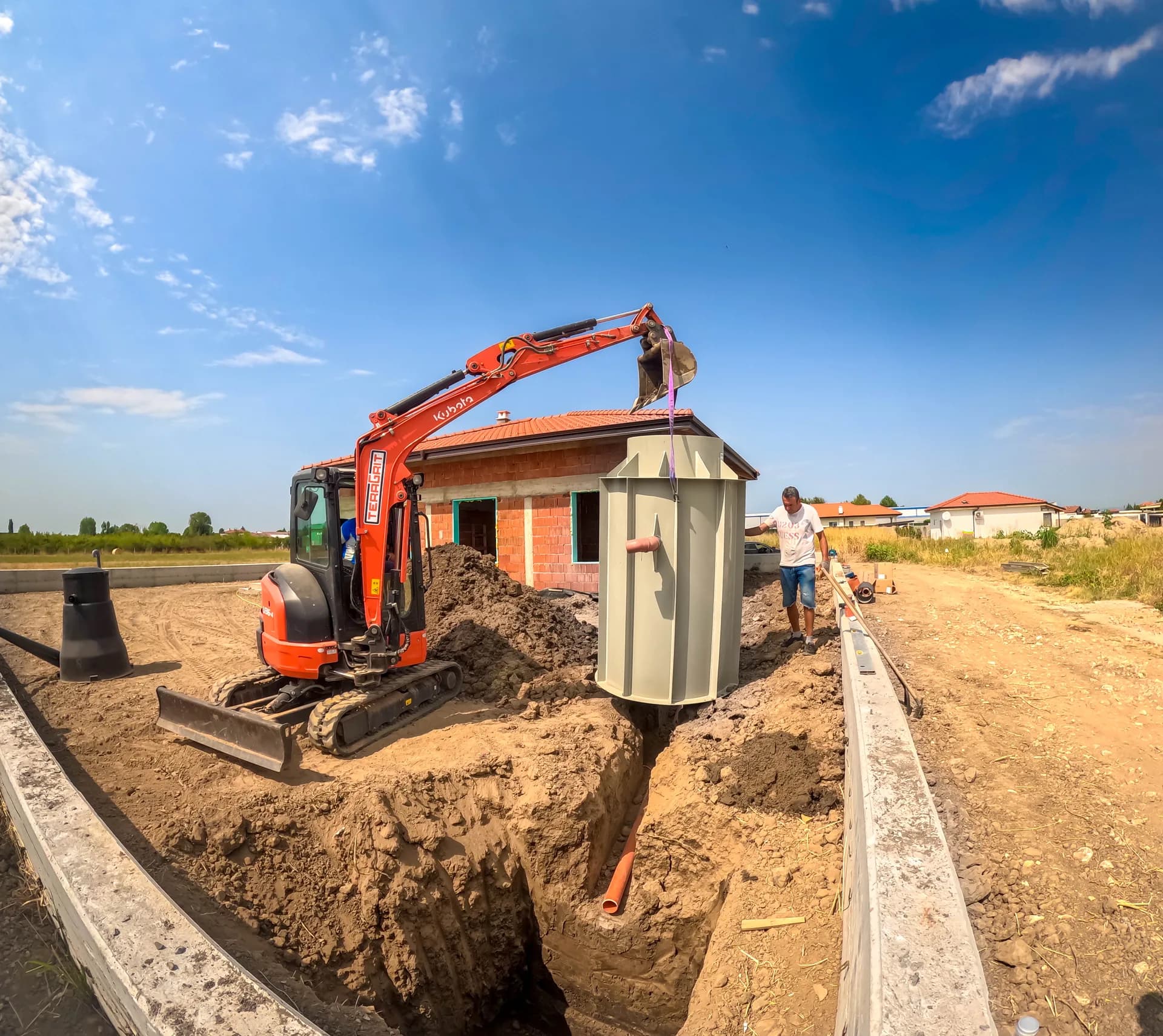
Installation is where quotations differ most. These are the items you should find in the text:
| Item | What to check | Question for the contractor |
|---|---|---|
| Excavation | By hand or machine, volume, removal of soil | Who pays if rock or water is found? |
| Base | Sand bed or concrete slab | Is anchoring needed for groundwater? |
| Backfill | Material and compaction | Is excavated soil reused or new material brought in? |
| Inlet pipe | Metres, diameter, inspection chambers | How many metres are included? |
| Discharge | Drainage field, chamber, connection to receiving water | Is it built by you or left to the client? |
| Electrical connection | Cable, breaker, blower location | Who connects it to the distribution board? |
| Commissioning | Filling with water, setup, test run | Is the owner shown how to use it? |
Discharge deserves special attention. Treated water has to go somewhere: a drainage field, a soakaway or a receiving water body. The solution depends on the ground and on the requirements of the municipality and the River Basin Directorate. If the quotation is silent on this, you may end up with a plant that has nowhere to release its water.
Hidden costs that appear after signing
From our experience at ERMAX BG, extra costs almost always come from a few predictable sources. Ask about them in advance:
- High groundwater. Requires dewatering of the excavation during installation, a concrete slab and anchoring against flotation.
- Rocky or heavy clay ground. Excavation is slower and may need different machinery. Clay holds water and affects the discharge solution.
- Difficult access. If the excavator or crane cannot reach the spot, the plant has to be moved and installed another way.
- Longer pipe runs. Quotations often include a set number of metres of pipe. Every extra metre costs more.
- Design and paperwork. Find out whether your property needs a design and who prepares it.
- Reinstating the site. Paving, lawn and kerbs around the excavation are usually not part of installation.
For more on what drives the final figure, read how much treatment plants cost and what the price depends on.
Warranty, service and spare parts
A plant will run for decades, so what the quotation says about the period after installation matters as much as the price. Check:
- how many years the tank is guaranteed and how many the blower and other electrical parts;
- under what conditions the warranty lapses, for example lack of regular servicing;
- who carries out service and how quickly they respond to a fault;
- whether spare parts, especially blower membranes and diffusers, are available in Bulgaria;
- whether the company offers a service contract and what it includes.
A low price without local service often means that at the first fault you will be looking for a technician who does not know the plant.
Timing, payment and validity
Besides the technical items, a quotation should include commercial terms. Check how soon after confirmation the plant is delivered and how many days installation takes. Ask whether the work depends on the season: frozen or waterlogged ground delays excavation. See how payment is split, for example a deposit on order and the balance after commissioning, and how long the quotation is valid. If two quotations differ on timing, decide what matters more to you: faster completion or a lower figure. All these terms should be written into the contract, not just agreed over the phone.
How to request quotations you can compare
The easiest way to get comparable proposals is to send every company the same information: the property's location, the number of occupants, photos of the garden and the spot for the plant, anything you know about groundwater and where you think the treated water could be discharged. Ask each company to break the price down by item.
Better still, ask for a site visit. An engineer on site sees things that do not show in a photo: the slope of the ground, access for machinery, distance to the building, neighbouring wells. A quotation after a site visit is almost always more accurate and has fewer surprises.
How we prepare quotations at ERMAX BG
For a single-family house we usually propose the BIO-6 treatment plant, and for a larger load we choose a model from the matching series. Our technical offer describes the model and capacity, the plant's documents, the scope of installation work, the discharge solution, commissioning, and the warranty and service terms. If something is not included, we say so explicitly so there are no surprises.
Frequently asked questions
Why do treatment plant quotations vary so much?
Usually because they cover different scopes of work: one is for the plant only, another includes excavation, installation, pipes and discharge. Compare item by item, not the total.
Is installation included in the price of the plant?
It depends on the company. Ask for the quotation to separate the plant, delivery and installation so you can see exactly what you are paying for.
What should I ask before accepting a quotation?
Ask what happens if groundwater or rock is found, how many metres of pipe are included, who builds the discharge and what the warranty and service terms are.
Do I need a site visit to get a quotation?
An indicative quotation can be given from photos and data. The final one is more accurate after a visit, because ground conditions, access and groundwater all affect installation.
If you want a clear, itemised quotation, contact ERMAX BG. One of our engineers will review your site and send you a technical offer listing everything that is included and everything that is not.